Are You a Good Seed?

Good Seed

I keep thinking of that little seed in the Gospel. “Unless the seed falls to the ground . . . and dies, it remains just a grain of wheat.” Jesus is telling us the purpose of the seed (its meaning) lies in “what it becomes”. John 12:21

We see this happening all around us this summer. The kernel of corn becomes a corn stalk which will bring ears of corn. An acorn begins the long journey of becoming an oak tree. The grain of wheat, the apple, pumpkin, tomato, wild flower seeds . . . all of them must die if we are to have the wonderful gift they bring. (Seeds in a bag? What good is that? Spread ’em around and be amazed!!)

Jesus tells us in this short brilliant image that we humans must “die to ourselves” and begin “living for others” and it’s when we do this that we discover who God made us to be. It brings a peace the world does not understand, a happiness no one can take away. And . . . it makes the world shine a bit brighter.

I can’t over emphasize how critical this “dying to ourselves” is, to discovering who we are and finding the path ahead for our lives.

It starts early in life when our parents teach us to “share”, “to shake hands and make up”, “to be gentle”. Later on, when life deals harder things, we’re challenged to “forgive”, “to go the extra mile”, “to comfort others”.

With practice, this thinking first of others becomes a habit, a character strength. It comes more easily with time and a quiet peace happens in one’s conscience . . . I’ve done the right thing. I feel clean. On the other hand, sadness comes most often when we realize we’ve put all our eggs in the wrong basket. The one marked “More For Me.”

It’s a cliché I know, but have you ever met someone with great financial resources, comforts and possessions the envy of all, yet someone who never learned the Lesson of the Seed? (It’s all there in the story of the Rich Young Man. Luke 18: 18-29).

(** Next week I’ll tell you a true story about a “Good Seed” I met at Rochester General Hospital. Tom was his name and I saw the love of Christ pour out of him in a simple but wonderful way. Me and my little seed felt puny next to him.)

So in the meantime, go be a good seed this week.

  • Stay a bit longer with “that person” who tries your patience.
  • Think ahead as to what might please your spouse. Do it.
  • Smile when you’re not feeling happy.
  • Say a prayer for someone who hurt you.
  • Find a way to encourage a young person to use their gifts.
  • Give some money away.
  • Someone disappoints you for the 100th time. Smile and find a kind word for them.
  • Sit with someone who needs company.
  • Think of a generous reason why someone might be so annoying. Forgive them.
  • Presume you’ve been that annoying too. Ask for par- don where appropriate.
  • Go out of your way to be kind to people who wait on you. A smile and a kind word can really help someone.
  • Know that any impulse to kindness and generosity is a grace given to you by God.

Have a good week you little seed you.

Fr. Tim

Scripture Readings for the 17th Sunday in Ordinary Time (all)

First Reading: Genesis 18:20-32
Responsorial Psalm: Psalm 138:1-2, 2-3, 6-8
Second Reading: Colossians 2:12-14
Gospel: Luke 11:1-13

Scripture Readings for the 18th Sunday in Ordinary Time (all)

First Reading: Ecclesiastes 1:2, 2:21-23
Responsorial Psalm: Psalm 90:3-6, 12-14, & 17
Second Reading: Colossians 3:1-5, 9-11
Gospel: Luke 12:13-21


Facebooktwitterlinkedinmail

Boomer Looks at Survivors and Millennials

Some years ago the priests of the Diocese of Rochester met for a two day conference to discuss the challenges we face in communicating the Faith to our parishes.

The focus was on “Young Adults and the Catholic Church”. A young adult was classified as someone from the age of 18 to 40. They comprise according to our presenters, 2 generations of humanity. (A generation spans roughly twenty years. Its members are joined by a common experience of nurturing, dramatic social moment, and a similar spiritual awakening.)

The two current generations of young people are called Survivors (age 22-42) and most recently Millennials (age 0-21). Of course no list of sociological theories can define any one person. We are all unique in how we process the world around us. Nevertheless, these were the hallmarks of the two youngest generations. See what you think.

Survivor Generation (Age 22-42)

Facts:

  • Most aborted generation in history
  • Parental divorce struck survivors harder than any generation
  • “Family” is defined in many and complex ways
  • Perceived as a “blacksheep” generation
  • Incarceration rate higher than other generations
  • Grew up underprotected
  • High incidence of “risk taking” behavior
  • Establishes a pragmatic lifestyle, tending toward privacy and reclusiveness

Millennial Generation (Age 0-21)

Facts:

  • Lowest child to parent relationship in American history
  • “Quality education” is raised as a political issue
  • Low birth rate–highly desired and nurtured children
  • Outward looking, unites in a heroic effort during a secular crisis
  • (This generation has many of the traits of the generation now passing away referred to lately as the “Greatest” Generation). The common experience? War.
  • Powerful builders and leaders.

These two latest generations have yet to make their full mark on our society. From personal observation I see two wonderful qualities in these young people.

  1. They value lifelong friendships and find strength in keeping close touch with one another even at a distance.
  2. These younger generations seem to be color blind. They’re not afraid to mix races and ethnic back grounds in forming their circle of friends.
  3. They’re practical. They want things to work. They’re not long on poetry or philosophy but their belief in technology will bring wonderful new developments to our lives.
  4. They are willing to volunteer to serve human needs. Wonderful!

So what does this all mean? It means we have to make room for each other. We have to find a way to welcome everyone. It means young people need to feel appreciated and valued for their particular gifts. It means that God’s gifts are revealed in all of His people.

We will make every effort at Holy Trinity Church to welcome our young people and to call forth the gifts God has given them to offer to the church. Young people will always be called to ministry in this community, as lectors, eucharistic ministers, catechists, peer counselors, parish visitors and evangelists. Along with their primary vocation as husbands/wives, fathers/mothers, our young will be an essential part of this worshipping community.

Young people. . . . . . hold us to this promise!

Fr. Tim

The Boomer Generation
(Disrespects authority and wants it all for free!)

Scripture Readings for the 16th Sunday in Ordinary Time (all)

First Reading: Genesis 18:1-10a
Responsorial Psalm: Psalm 15:2-3, 3-4,5
Second Reading: Colossians 1:24-28
Gospel: Luke 10:38-42

Scripture Readings for the 17th Sunday in Ordinary Time (all)

First Reading: Genesis 18:20-32
Responsorial Psalm: Psalm 138:1-2, 2-3, 6-8
Second Reading: Colossians 2:12-14
Gospel: Luke 11:1-13

Facebooktwitterlinkedinmail

Addiction (Part 2). You can’t. God can.

Let’s begin this reflection with a promise given to us by God. “For I am convinced . . . that neither death nor life, neither angels nor other heavenly rulers or powers, neither the present nor the future, neither the world above or the world below, there is nothing in all creation that will ever be able to separate us from the love of God which is ours through Christ Jesus our Lord.” Romans 8:38.

That said, the power of addiction will be overcome by God’s grace. Period. God does not want His children in bondage. So we need to find a way to let the power of the love of God into this dark and scary place. How do we do that?

It’s probably best to turn to those who have experienced a release from their addiction. The first people that come to mind are our brothers and sisters in the 12 Step Program of Recovery. Over the years they have discovered a certain path to victory over addiction to food, alcohol, pornography, gambling, etc. These 12 steps, if followed with docility and humility, will lead to freedom from addiction.

I want to focus on the first three steps as I feel they hold the key to all that follows.

Step 1: We admitted we were powerless over __________.

Step 2: Came to believe that God (my Higher Power) could restore us.

Step 3: Made a decision to turn our will and our lives to the care of God.

Here I think is the genius of the 12 Steps. It comes by admitting we’ve lost the battle. The addiction is just too big and too strong to hold out against. Every time it’s me vs. my addiction . . . I lose. How do I know that? Be- cause I’ve tried a 1000 times to NOT do that and a 1000 times I failed.

So the key to “sobriety”, as they say, is to admit I’ve lost. It’s a moment of terrible honesty with oneself when we admit “I can’t control this. It controls me.” This takes real humility. Our enemy the devil, sows seeds of protest in our mind, “No!”, we say, “I could stop if I really tried. I’m not a loser here.”

That’s a lie. Here’s the terrible truth . . . I’ve lost the battle. It’s over. I’ll never overcome this addiction. We have to give up trying to fix this by ourselves. Because we can’t.

So . . . now what? Just give up and give in? Of course not! Something very positive has just happened. We’ve admitted the truth – “we can’t”. There is no shame in this. It’s just the way it is.

But now comes the positive side, something you can DO. Steps 2 & 3 point to a moment when “we came to believe that God will help” and “we made a decision to turn our will and life over to the care of God.” (I have to emphasize that this “came to believe . . . God” is totally blind and without a foothold. It’s like bungee jumping into the Grand Canyon . . . at midnight.) He’s there. Trust the promise.

It’s like saying, “I can’t God. But you can . . . if I get out of the way.” Then the daily repetition of these steps begins (sometimes out loud to God in prayer). “I can’t Lord. You can. I’m yours. Do what you want with me.” Daily . . . daily . . . we have to return to these steps: surrender, believe in that power beyond yours, and give Him charge of your life.

Slowly, sometimes quickly, the compulsion to engage your addiction weakens. It doesn’t go without a fight however. It uses many tricks and voices in your head to try to convince you how futile are your efforts. “You’ll never lick this. Think how boring and cold life will be without me to comfort you. You’ll never make it without me (your addiction).” All lies.


So much more to consider on this topic, but for now I think if we focus on two things: 1. “I surrender . . . I’ve lost the battle.” and 2. “I’m in your hands Lord. I’ll be the clay; you be the potter.” You will begin to see God’s freedom dawn on you.

Enjoy these summer days.

Fr. Tim

Scripture Readings for the 15th Sunday in Ordinary Time (all)

First Reading: Deuteronomy 30:10-14
Responsorial Psalm: Psalm 69:14, 17, 30-31, 33-34, 36, 37
Second Reading: Colossians 1:15-20
Gospel: Luke 10:25-37

Scripture Readings for the 16th Sunday in Ordinary Time (all)

First Reading: Genesis 18:1-10a
Responsorial Psalm: Psalm 15:2-3, 3-4,5
Second Reading: Colossians 1:24-28
Gospel: Luke 10:38-42

Facebooktwitterlinkedinmail

Help me. I can’t stop.

“These things are addictive,” he said as he finished the bag of honey roasted peanuts. We all know what that means in an everyday sort of way. There’s something that tastes so good, and repeats itself with each mouthful that’s it’s hard to resist eating too much of it.

But, in the common mind, it doesn’t qualify as a real addiction until we experience an inability to stop. It becomes a way of acting to which we are driven (even in spite of our better judgment). Where does this strange power over us begin?

St. Thomas Aquinas would tell us, it begins with something quite good: stimulation, comfort, ecstasy, release, approval. Many earthly activities bring about enjoyable psychological states to insure repetition. Food sustains life, the intense pleasure of sex ensures human conception. They are nature’s strong inducements but by them- selves they are not necessarily addictive.

What makes a particular thing addictive is its power to mesmerize, to outgrow the desire for other human experiences. There comes a point where, to NOT be in that state (full, high, aroused) is experienced as a deprivation, a sort of poverty. I’ve begun now to prefer my addiction to all the other states of being. I’m always looking to increase the time I might spend with it.

At this point the addictive power begins to limit human freedom. (The New Testament uses the term “slavery” in describing our attachment to this behavior). It will not quietly take its place amongst other human activities. Like the moon which disappears at sunrise, the other good things of life can’t compete with the blinding desire of addiction.

Moments like, kindness, friendship, generosity, humor, communication, as good and pleasurable as they are, are not addictive because they lack the power to overwhelm. One experiences these moments without others losing their comparable appeal. They are psychological states freely chosen amongst other human offerings. Their appeal does not remove other choices, even some less pleasurable.

Where does the addiction get its power? Science has been hard at work to unwrap the phenomena of addiction. They tell us over time the repeated brain waves of intense pleasurable action wears a pathway in our brain. Along this frequently used brain path travels powerful pleasure inducing hormones (pheromones) producing the increasingly desired effect. In effect the brain has found a shortcut to feeling of “well”. It’s only a matter of time that this easy “wellness” becomes the preferred state from which to engage the world. All addiction is, at least partially, a drug addiction (the pheromone release in my brain.)

Other addictive theories are more behavior based. But they too have a “pain relief” purpose. Psychologists tell us we all have elements of emotional pain in our lives. Some pain is life long and comes from traumatic instances in our youth. Others, less dramatic but chronic (loneliness, depression, fears, boredom etc.), can turn to certain behaviors that self-medicate painful emotional states.

For example, a person tied to a job she hates, without family or friends to enjoy life with, with little or no hope for anything changing for the better can self-medicate at the casino, the bar, the internet, the kitchen etc. . . . . any- thing to change the low emotional wellness level. Something as simple as a cigarette can bring an addictive comforting (I know this one personally.)

Let’s be honest. We all run the risk of finding something to which we are inclined in an unhealthy, addictive way. Feeling his weak human nature St. Paul writes to the Romans, “My inner being delights in the law of God. But, in my body I see a different law. A law that fights against the law of God . . . I don’t understand what I do; for I don’t do what I want to do, but instead I do what I hate. What an unhappy man I am! Who will rescue me from this body that is taking me to death?” Romans 7: 14-25.

The answer of course is God. But we need to understand what we must do so God can do His part. We’ll look at that next week.

In the meantime I beg you . . . please know that God has a healing for our addictions. It starts with the Truth. “And the truth will set you free.” That’s a promise.

Enjoy this summer weather. It’s not addictive!

Fr. Tim

Scripture Readings for the 14th Sunday in Ordinary Time (all)

First Reading: Isaiah 66:10-14c
Responsorial Psalm: Psalm 66:1-3, 4-7, 16, 20
Second Reading: Galatians 6:14-18
Gospel: Luke 10:1-12 17-20

Scripture Readings for the 15th Sunday in Ordinary Time (all)

First Reading: Deuteronomy 30:10-14
Responsorial Psalm: Psalm 69:14, 17, 30-31, 33-34, 36, 37
Second Reading: Colossians 1:15-20
Gospel: Luke 10:25-37

Facebooktwitterlinkedinmail

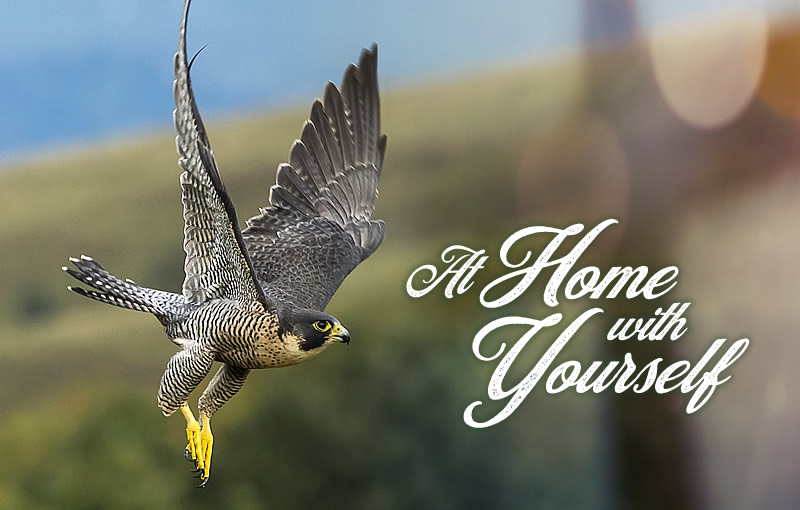
At Home with Yourself

W. B Yeats called it the ever “widening gyre” *. The image was of a falcon and the falconer who calls the bird to its roost. The bird has flown to a distance it can no longer see or hear its master. “The falcon cannot hear the falconer. Things fall apart. The center cannot hold.” The poem refers to the forces of history or culture that take a person and a civilization away from their true self.

Something like this happens in every age of history. Its effects appear in our culture today and our young people are most severely affected. We’re losing a sense of our center, our true selves, and what is most disconcerting – – we don’t sense the loss. The forces that separate falcon from falconer are many and complex. To keep it simple we can point to an imbalance of the “inner world” and the “external world”.

The inner world refers to that realization a person has of himself. His center. His likes and dislikes, personality, characteristics and values. It’s our soul, our center. It’s the “me” that turns when I hear my name called.

The “outer world” of course is that environment outside ourselves; events, persons, circumstances in which we act and are acted upon. Some have called it “the daily grind”.

Between these two poles, my human life happens. I go out of myself to encounter the world and the people it brings. Then I return to the inner world and the conversation begins. “What was that? Why did that happen? Did I do the right thing?”, etc.

These two poles of life, the going out and the returning “home”, need to be in balance. The problem is the world with its unending chatter of social media, news and en- tertainment, overwhelms the “inner person.” There’s no home in ourselves to return to. We are in turmoil. Things fall apart.

In those rare moments when television or internet are turned off, we can grow restless or slightly embarrassed to be “alone with ourselves”. The sudden quiet catches us off guard and in the silence a weird feeling of being a stranger to ourselves comes over us.

To meet ourselves in such a moment can even frighten us. “Who is this person? It’s ME!!” Oh dear. Me. “What am I going to do with me?”

And so we check our email, text someone, see what’s on TV, phone somebody . . . anything to avoid being with myself.

This estrangement from ourselves has sad consequences for our relationship with God. How can we hear the voice of God if we can’t hear the voice of our own conscience- (that inner voice urging us to “do this” or “don’t do that” or “good job!” or “shame on you.”)

Remember Jesus telling us “when you talk to God (pray) go to your room. Close the door. And pray to your Father in secret.” Mt. 6:5,6? Why in secret? Because the way God chooses to speak to you is as a friend. And friends give each other their full attention. A friend speaks per- sonally to you like no other, many times quietly, just between the two of you.

In the quiet, over time, we return to ourselves and begin to hear things in our heart once again. I remember one year on retreat at a monastery walking down a country path. Suddenly it happened . . . I heard the wind blowing through the trees. I mean I HEARD THE WIND. I heard it because I was LISTENING.

Later on, if you continue to listen, you can hear the things your heart has wanted to tell God. “Lord, it’s me. I just want to tell you . . .” Many times it’s just being aware of your feelings and giving them to God “who sees.”

So, how to end this? Get quiet. Put down the iphone. Come home to yourself. Re-aquaint yourself to what you’re feeling, thinking, loving, fearing. Then. . . turn to Him. Speak anything (anything!) you want to get off your chest, be grateful for, need help with.

He is there. “Your Father who hears in secret. . . knows what you need.” Mt. 6:8

That is a promise from Christ.

Trust Him.

Fr. Tim

* W.B. Yeats, The Second Coming

Scripture Readings for the 13th Sunday in Ordinary Time (all)

First Reading: 1 Kings 19:16b, 19-21
Responsorial Psalm: Psalm 16:1-2, 5, 7-11
Second Reading: Galatians 5:1, 13-18
Gospel: Luke 9:51-62

Scripture Readings for the 14th Sunday in Ordinary Time (all)

First Reading: Isaiah 66:10-14c
Responsorial Psalm: Psalm 66:1-3, 4-7, 16, 20
Second Reading: Galatians 6:14-18
Gospel: Luke 10:1-12 17-20

Facebooktwitterlinkedinmail

19 to 2110

We’ve often mentioned the different states in life that contain their own special vocation: the single life, married life and consecrated religious life (priesthood/sisterhood/brotherhood). Each “state” in life presents different ways of living out the one vocation we all have – – – to bring the love of Christ to the world.

Here at Holy Trinity we’ve kept careful record of the different vocations God has called forth from the people. So let’s see . . . in the last 80 years 19 men and women from our parish have been given the vo- cation to the religious life as a priest (6) or sister (13). (5 men have also been called to the diaconate.)

Guess how many men and women have been called by God to the married life? Over 2100. Why so many more married persons than religious life? God wants more families. God wants more children in His Kingdom! And that means He wants more husbands and wives.

Marriage has to happen before there’s anybody to even think about becoming a priest or a sister!

Marriage is the state in life that suits most people. It is the life that touches the deepest longing of the human heart — where we learn to love and be loved.

Here we receive the wonderful gift of family which gives us that necessary human experience of “belonging”. (I’m so glad my mother and father fol- lowed God’s plan for their life. My life was given to me because of it.)

It is a personal consolation to me to know that my life as a priest was the result of an invitation from God. I hope and pray that our young people here at Holy Trinity will begin to see in their fiancé not just a beautiful, nice, fun person but see in them God’s gift. And to take strength and courage that it is God’s idea that they love each other and live their lives together.

This is the strength that comes to us in our “vocation”. It’s not just our personal choice of how to live life — it is God’s invitation to share life with someone hand picked by the Holy Spirit for you. This trust in God’s intention for a married couple can strengthen them when life proves difficult. Despite feelings to the contrary sometimes, “this is exactly where God wants me to be. And so I trust in His help.”

Do you begin to see the strength that our faith brings to a marriage? Girls, look for a young man who goes to mass. Boys, the mother of your children could well be in line for communion ahead of you.

Lastly . . . young people . . . pray for your future spouse . . . that God will keep them safe up to the day you meet them for the first time!

I imagine God asking husbands and wives at the gates of heaven, “Did you love her?” “Did you love him?” “Like I showed you in my Son?”

God loves you more than you know.

Fr. Tim

Scripture Readings for the Most Holy Body and Blood of Christ (all)

First Reading: Genesis 14:18-20
Responsorial Psalm: Psalm 110:1,2,3,4
Second Reading: 1 Corinthians 11:23-26
Gospel: Luke 9:11b-17

Scripture Readings for the 13th Sunday in Ordinary Time (all)

First Reading: 1 Kings 19:16b, 19-21
Responsorial Psalm: Psalm 16:1-2, 5, 7-11
Second Reading: Galatians 5:1, 13-18
Gospel: Luke 9:51-62

Facebooktwitterlinkedinmail

Dad.

My sisters are always warning me about pigeon-holing people. You know, things like . . . “Well that’s because he’s Irish (or Italian, or German, etc.). You know how they are.”

Most times I think it’s done with an appreciation for the gifts that certain cultures offer to the world. (Who but Italians could have given us all those amazing operas and the tenor voices that delivered their story?) It’s not pigeon-holing when what is pointed to is clearly “a gift”.

The same observations can be made about the different gifts of men and women. So on this Father’s Day let this be an “ode” to fathers and the gifts they bring to their wives and us children.

(What follows in no way lessens the true love that same sex couples have for their children and the critical role they play in their lives.)


What is it that makes a good husband and father?

First on the list is a requirement of nature. A father needs to be a man. This is for the purpose of children of course. But there’s more than biology happening here.

Children need nurturing, guidance and protection. Is it fair to say women have a particular genius in knowing and feeling along with their children? I think they do. I also think their hearts are more ready to embrace and comfort.

This does not mean that men have none or little of these traits. They have them for sure. But a father would be wise to defer to a mother’s intuition about her child’s emotional well-being.

I’ve asked young brides-to-be what attracted them to their fiancé; among other things, many said they thought “he would make a good father.” This man attracted them in that they were already thinking of their child – – – yet to be conceived!

So what makes a good father? (We’re all free to list our qualities, right?) Here’s mine:

  • A father is the guarantor of safety in the home. The children need to know that dad is in the house and all will be well through the night. There’s a noise downstairs? Dad, you check it out.
  • A father is a “court of final appeal”. When everyone’s stated their case (mom first of course) and a decision still can’t be reached, dad takes responsibility for the well being of the whole family. Not as a boss but as a loving leader.
  • When children become teenagers and are physically mature, there’s a tension in them that needs to “test things out for themselves”. Dad has to be there to match their strength with his own (especially with boys). A father will listen and consider the children always. But he won’t be bullied.
  • He puts his wife closest to his heart.
  • Dad’s first duty was to be our father; only after that could he be a friend.
  • A father’s strength helps us to enter the “world out there”. . finding a job, a career, pointing out dangers, giving us confidence that we can make it in this world.
  • Dad is happiest when his wife and children are happy. And if not, he does his best to make things better. He’s a fixer.
  • Dad believes in God. He leads us in prayer at the dinner table and at night before bed. He is the muscle that gets us to mass on Sunday. He’s anxious to model Christ’s virtues . . . especially faithfulness, sacrifice, forgiveness, courage and tenderness.

Dear Dad. Please know that we love you and for better or worse . . . we grew up! Thanks for your love and sacrifice throughout these years. We’re better persons because of you.

Fr. Tim

Scripture Readings for The Solemnity of the Most Holy Trinity (all)

First Reading: Proverbs 8:22-31
Responsorial Psalm: Psalm 8:4-5, 6-7, 8-9
Second Reading: Romans 5:1-5
Gospel: John 16:12-15

Scripture Readings for the Most Holy Body and Blood of Christ (all)

First Reading: Genesis 14:18-20
Responsorial Psalm: Psalm 110:1,2,3,4
Second Reading: 1 Corinthians 11:23-26
Gospel: Luke 9:11b-17

Facebooktwitterlinkedinmail

Anointing of the Sick

Anointing of the Sick

Saturday, June 15 at 10:30 am

One of the most debilitating things about sickness is not the pain, or the fatigue, or the fear (each of these are, of course, part of the cross sickness brings). No. One of the biggest sufferings is how illness separates us from those around us – our families, friends and community at large.

It may mean being confined to home or quarantined from those closest to us. It may mean being unable to participate in everyday activities that bring us together with others. Perhaps most upsetting is the feeling of being “set apart”, different from others. (The thought “I’m sick”; everybody else is ok”.)

Holy Trinity Church has scheduled a Eucharistic Celebration with the Anointing of the Sick. This is the chance to bring some of your health concerns to the Lord in the context of mass and this faith community.

You are not alone! The Lord and Holy Trinity hold you dear to our hearts in prayer. There will be special seating for those who wish to be anointed that morning.

WHO SHOULD BE ANOINTED? The guidelines for the sacrament say “any persistent and serious concern for one’s health…” is reason for someone to request the anointing. Health concerns such as depression, anxiety, addiction, spiritual doubt and chronic pain are all suffi- cient to receive the anointing. There will be no questions asked. Simply indicate your wish to be anointed.

Come by yourself or better … bring a friend. Experience the healing and comforting Hand of God working through the Sacrament of the Sick and the care of this parish.

God bless you.

Fr. Tim


Senior Ministry at Holy Trinity

Are you looking to connect with fellow parishioners and or receive some spiritual encouragement outside of Sunday Mass? How about a chance to share your God-given gifts with others in your community? Holy Trinity is ex- cited to announce the beginning of our Senior Ministry.

The ministry mission statement declares that we will tend to the social and spiritual needs of our senior parishioners but, our hope is that senior events will provide something much broader. The future of this ministry will be shaped by YOUR wants and needs. The possibilities are endless; how exciting!

To get to know those among you that would like to participate in such a ministry, our first event will be a Potluck Luncheon on Thursday, June 20th from 12-2 pm in the Gathering Space. Please call the Parish Office at 265-1616 to reserve your spot.

So, the big question is this: As an “over-55” adult, what do you like, want and need to do? A survey has been assembled to answer just that and will be available at the luncheon.

If you are unable to attend the Potluck Luncheon on the 20th, surveys will be available for you at the Welcome Desk.

We look forward to exploring this new adventure with our senior parishioners!

For more information, please contact the Parish Office at 265-1616.

It will be a ton of fun!!!

Scripture Readings for Pentecost Sunday (all)

First Reading: Acts of the Apostles 2:1-11
Responsorial Psalm: Psalm 104:1, 24, 29-30, 31, 34
Second Reading: 1 Corinthians 12:3b-7, 12-13
Gospel: Romans 8:8-17

Scripture Readings for The Solemnity of the Most Holy Trinity (all)

First Reading: Proverbs 8:22-31
Responsorial Psalm: Psalm 8:4-5, 6-7, 8-9
Second Reading: Romans 5:1-5
Gospel: John 16:12-15

Facebooktwitterlinkedinmail

All of You.

All of You

I’m thinking of a spiritual lesson I’ve had to learn over and over in my life. It’s the simple fact that God wants all of me.

What do we mean when we say “all of me” (all of you)? Think of our many parts . . . our mind and its reasoning, our memory, our desires, our freedom, our work, talents, relationships etc. God wants to be in charge of all these things.

The problem is I want to be in charge of them. After all . . . It’s MY life!!

So throughout my life, I’ve tried to strike a deal with God. “I’ll give you most of me Lord. You can have my work and those work relationships. You get back what gifts you’ve given me (my big mouth). I’ll even throw in what kind of TV I watch (nothing smutty, you wouldn’t like that). All this is Yours.”

“But . . . don’t ask me to give you my habits or my preferences. I’ve spent a lifetime developing them: my bedtime, my cocktail, my personal time, a particular hobby, etc., all these are mine. I’ll do what I want with them.”


So God is patient. He lets us have our way. Habits and preferences (even the good ones) start to protect themselves. To the point where they can start to run the show. We start living in a way that expects these habits to have no interference. (“What do you mean the plane is delayed? This just can’t be. I have to be in Rochester this evening!!” OR “No coffee!!? That’s ridiculous!”)

Once again God lets us have our way. And I don’t know about you, but every time I take free reign of my life, with no concern for God’s will (I’m a good guy – – I don’t need God’s will to tell me what to do) . . . things get muddy.

It’s weird. I start out wanting a little “life for myself”. God won’t mind. And now I discover there’s a growing part of me that doesn’t want God interfering with my habits at all.

Now look what’s happened to God. God becomes “the Law”, the cop in my rearview mirror. A kill joy, someone to fear or at least avoid. This friends is the effect of original sin in us. God is someone to flee.


Poor God. How we twist things about Him. How we make Him out to be some grumpy boss who loves to order people around. Our vision of life slowly changes. Happiness is something to be grasped by ourselves. God is someone to flee. Adam and Eve hid themselves.

So what went wrong? We did. We failed to give God everything. Call it what you want . . . mistrust, selfishness, pride, arrogance . . . it’s all the same. It’s a voice that says, “NOBODY IS GOING TO TELL ME WHAT TO DO.” Quietly God calls to us but we’re not in the mood to listen.

Ever have that feeling? Ever hear yourself saying that? Welcome to this fallen world.


We’ve forgotten that God loves us. We’ve forgotten that, in His knowing love, He knows us better than we know ourselves. He made us! And it’s from this love we receive His will. And, get this. God’s will is our true happiness! St. Ignatius of Loyola, founder of the Jesuits, prayed this prayer (The Suscipe) for God to have all of him. See what you think.

Take, Lord, and receive all my liberty,
my memory, my understanding,
and my entire will,
All I have and call my own.

You have given all to me.
To you, Lord, I return it.

Everything is yours; do with it what you will.
Give me only your love and your grace,
that is enough for me.

~ St. Ignatius of Loyola

Next Week Pentecost!!

Fr. Tim

Scripture Readings for the 7th Sunday of Easter (all)

First Reading: Acts of the Apostles 7:55-60
Responsorial Psalm: Psalm 97:1-2, 6-7, 9
Second Reading: Revelation 22:12-14, 16-17, 20
Gospel: John 17:20-26

Scripture Readings for Pentecost Sunday (all)

First Reading: Acts of the Apostles 2:1-11
Responsorial Psalm: Psalm 104:1, 24, 29-30, 31, 34
Second Reading: 1 Corinthians 12:3b-7, 12-13
Gospel: Romans 8:8-17

Facebooktwitterlinkedinmail

Jesus Over Cocktails

cocktail

So there’s a lull in a conversation with friends and someone you know, but not all that well, asks you, “Have you accepted Jesus as your Lord and Savior?” Everything stops, doesn’t it?

Catholics especially find it hard to answer this question. “I THINK I have,” might be our answer. Pressed further as to when you accepted Jesus someone might say, “Well, I go to mass on Sunday”, “I don’t cheat anybody.” “I give to the United Way.” “Oh I don’t know!”

It’s not through any lack of faith that one is left in confusion. It’s just that most Catholics show our faith in a different way. Taking Holy Communion at mass is probably the premiere moment for Jesus and me in the week. Yes, THERE HE IS, my Lord and Savior! (Chances are, our inquiring friend would not understand this answer) . . And just before that we turn to each other and say, “The Peace of Christ be with you!” and we smile at each other and somehow we feel Jesus is with us.

That’s it. That’s Jesus and me. And is He my Lord and Savior? Of course He is!

However . . . that’s not enough. Faith is a gift that is meant to be shared. Christianity is not just about “Jesus and me”, it’s about Jesus, you and me, all of us together. (Why else would Jesus leave the 99 safe in the meadow to search out the lost sheep?)

So how do we uptight Catholics begin to share our faith? It starts with an attitude of affection. We have to like our neighbor, to genuinely care how they are, to be happy when they are happy and sad when they are sad. Not that everyone is our best friend, but everyone can count on us to be in their corner. We want goodness to find everyone.

Once we have our neighbor fixed in our hearts as “brother” or “sister”, we can speak to them as to a friend — because that’s what they are.

Next we need to check our memory bank for the times God has popped up in my life. These are moments when I cried out to God and He heard me, or a joy beyond all expectation filled my heart. These are my life’s faith stories, my “God history.” These things I know, not because I read about them, but because they happened to me personally. These are the things that Christ asks me to share with my neighbor when the Holy Spirit moves.


So how do I find my “God history”? It really is up to each person to search and find. But here are a few classic moments that many people have found to contain “something from God”.

  • Strangely, God’s grace comes many times in moments of distress. “Powerlessness” is a particular favorite for God to work with. The times, with nowhere else to turn, we finally call out to God . . . “Help me.” And guess what? Something happens.
  • “Things that overwhelm” is another favorite tool God uses to open our eyes. Moments of great beauty in a thou- sand different places (the face of a child, a walk with a friend, something said in church, the memory of a loving person, sickness that brings a new vision of life, someone’s word to us that goes deep, etc.)
  • Where there is love there is God (1 Jn. 4:7). Any moment of love whether small or large is a golden thread that leads directly to the heart of God. God IS love. (A love beyond all measure. Think “giving” without counting the cost – – Christ on the cross). Have you witnessed this kind of love? Then God has come to you!

God will give you a time to share your confidence in His grace. Because you’ve experienced it.

Be kind this week.

Fr. Tim

Scripture Readings for the 6th Sunday of Easter (all)

First Reading: Acts of the Apostles 15:1-2, 22-29
Responsorial Psalm: Psalm 67:2-3, 5,6, 8
Second Reading: Revelation 21:10-14, 22-23
Gospel: John 14:23-29

Scripture Readings for the 7th Sunday of Easter (all)

First Reading: Acts of the Apostles 7:55-60
Responsorial Psalm: Psalm 97:1-2, 6-7, 9
Second Reading: Revelation 22:12-14, 16-17, 20
Gospel: John 17:20-26

Facebooktwitterlinkedinmail